

Creating a Fantasy Calendar
Year 12 maths vs ChatGPT fail

When I sat down to tackle the fourth draft of Wildelore, I took a few months off writing to build out the world of Wildelore in much more detail than I previously had.
I did flora and fauna deep dives, googling, chatgpting, midjourneying, creating figma boards of woodlands and marshlands and inventing breeds of horses and goats and all sorts of things.
What I enjoyed perhaps more than anything was creating the Wildelore calendar, and cosmos.
But I had a very interesting problem to solve…
I decided I wanted three moons in orbit around the planet our tale is set on, which is called Daer, in the native Eirian language.
One “tidal” moon, which set the cycle for the moons (months), which are 24 day cycles, new to full and back to new moon. This silver moon I called Gaele, but it’s more often called the Maiden Moon or the Tidemoon.
The second moon, Llua, the Fae Moon, is aligned with the seasons, on a 72 day cycle.
And finally, the third moon, Feyre, the Blood Moon, which would have a longer cycle.
Without giving anything away, there is a specific date the prophecy in the story references, which is the harvest equinox, in the year 875 AC (After the Coming). This is the 180th day of the calendar year.
This date is a rare event called the Triune Equis, where all three moons are full. I wanted this to only have happened before in the year zero, which was an event called The Coming of the Gods of Man.
So that meant the third moon’s cycle had to be set so that the three moons would be full together only once every 875 years and whatever days. Which is around 252,000 days.
Anyway, the maths got reasonably complicated, and so I turned to ChatGPT to help. I got a 25 page calculation back. I mean, who the f**k knows, right?
But I was actually pretty good at maths back in year 12, and so I worked it slowly through, step by step. Turns out the old AI brain had made plenty of errors. So I ended up solving it myself, and came up with a 160 day cycle.
The neatness of the number concerned me, but I tested it, and it turns out that a 24, 72 and 160 day cycle will only come together once in 252,100 days, which worked out well for me.
So then I plotted out in a spreadsheet the lunar calendar over the two year period the series spans.
It looks like this…
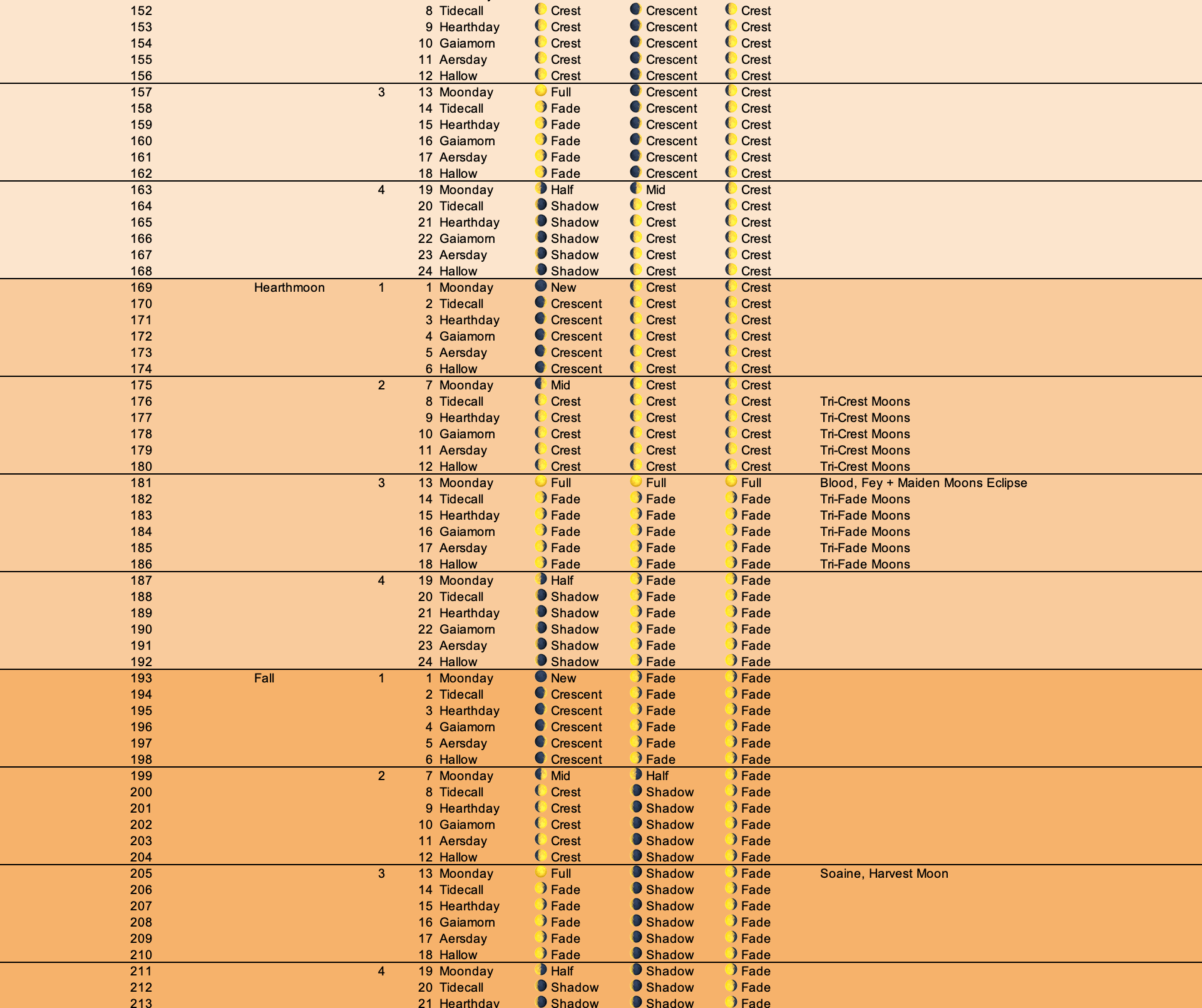
So not only did I get to solve the timing of the big, climactic event, I got to see exactly where each moon was at in the sky on any given day in the story.
Which my nerd brain get very excited about.
For me, even though this is fantasy, it’s important things are plausible. As much as possible, I want the science to stack up. That includes topography, climate, flora and fauna, lunar cycles, seasons, and also human emotions, motivations, arcs, politics.
I think there are enough fantasy readers who are nerds like me with “a touch of the tism”, as my daughter likes to tell me I have, that we notice these things, and appreciate when a writer has put the thought and work in to make it all stack up.
I’ll share with you now the rest of the details of the Wildelore Calendar, for those of you interested…
WILDELORE CALENDAR
Year (Yare)
The concept of a year, as it is in our world, is the planet’s trip around the sun. In world, however, it is thought of as a "cycle" of the seasons, and is called a "yare" (Eirian).
In different cultures, the yare is measured in the passing of different seasons. In Eiriador, they count the passing of harvests. In Kaldan, it’s summers.
Seasons
The seasons very much mirror ours here on earth. Each season has an elemental foundation.
Bloom (Spring) - water element
Summer - fire
Harvest - urth
Winter - air
Bloom and Summer are inhales, Harvest and Winter are exhales, in the breath of the world.
Moons (months)
Moons are 24 days long, making the seasons 72 days, and the full yare 288 days. The planet of Daer is slightly smaller than Earth, and orbits a little closer to Aure, the sun, which is a little smaller and less hot than our sun, which means the climates are very similar.
I wanted the world Wildelore was set in to feel familiar, so that the reader isn’t always in fantasy mode. So the characters and their experiences as they move through the world can be relatable, and the fantasy elements are just as foreign as they may have been in our more ancient times.
Rooted in fear and superstition for most folk.
Here are the twelve moons of the lunar calendar:
Bloom
Springtine - thawing, stirring
Greenvoll - greening, rising
Wildbloom - blooming, opening
Summer
Aurlight - brightening, warmth
Midsummer - highsun, peak
Goldening - ripening, sweetening
Harvest
Reaping - harvest proper, gathering
Hearthmoon - gleaning, graining
Fall - leaves drop, preparations for winter
Winter
Frostmorn - winds, storms, frost
Whitemoon - stillness, darkness, snowfall
Nightveil - winter’s sleep, whispers before the bloom
Turns (weeks)
Each moon is broken up into 4 phases, which are the turns.
New/Darkmoon to Crescent - days 1-6
Midmoon to Crestmoon - days 7-12
Brightmoon to Fade / Moonwane - days 13-18
Halfmoon to Duskmoon / Moonshadow - days 19-24
A turn (week) is 6 days.
Days
Moonsday - the moon’s shift begins the turn
Tidesday - movement, energy, action
Hearthsday - home, craft, tending
Gaiamorn - creation, connection, nurture
Aersday - thought, decision, endeavour
Hallow - the rest or reflection before the turning
Tides (hours)
The term “tides” doesn’t directly reflect the movements of water, but rather the tides of a day and night.
There is no keeping of time in hours, minutes, seconds, etc. The tides measure the points of the day, aligned with Aure, the sun’s position in the sky.
Dawn - the rising of Aure
Morntide - Aure climbs in the sky, beginning of light
Noontide - Aure’s zenith
Afttide - Aure falls toward the horizon
Dusk - setting of Aure, end of light
Twilight - first stars, shadows of the day
Eventide - the evening
Midnight - night’s zenith
Veiltide - deep hours of the night
Witching Tide - the night is stillest and coldest
False Dawn - or fool’s dawn, the lightening before Aure rises
As you can tell, I wanted to keep close to our own experience of the movement of time, days, moons, etc.
But without any Roman origins.
So much of what we use today was set or bastardised by the Romans, and before them the Greeks.
Removing the concept of an “hour” was actually more challenging than I expected, and I constantly caught myself referencing it in the passing of time, and having to let go of such controlled measures.
I drew on a lot of Celtic culture and mythology around seasons, as I wanted the measures and beliefs rooted in and guided by nature, for Wildelore. Certainly for the people of Eiriador.
Anyway, that’s where it’s landed so far, no doubt some things may still change pre-publication, but I’ve worked with this system for a book and a half so far, and it feels quite comfortable.
Thanks for reading down to here, and feel free to send me your questions or thoughts!
Take care and be wilde,
Andre