


Welcome, reader, to the world of Wildelore.
You are among the first in the world to read this epic fantasy saga, chapter by chapter, before it is even published.
You can find a full index of chapters released here.
Enjoy…
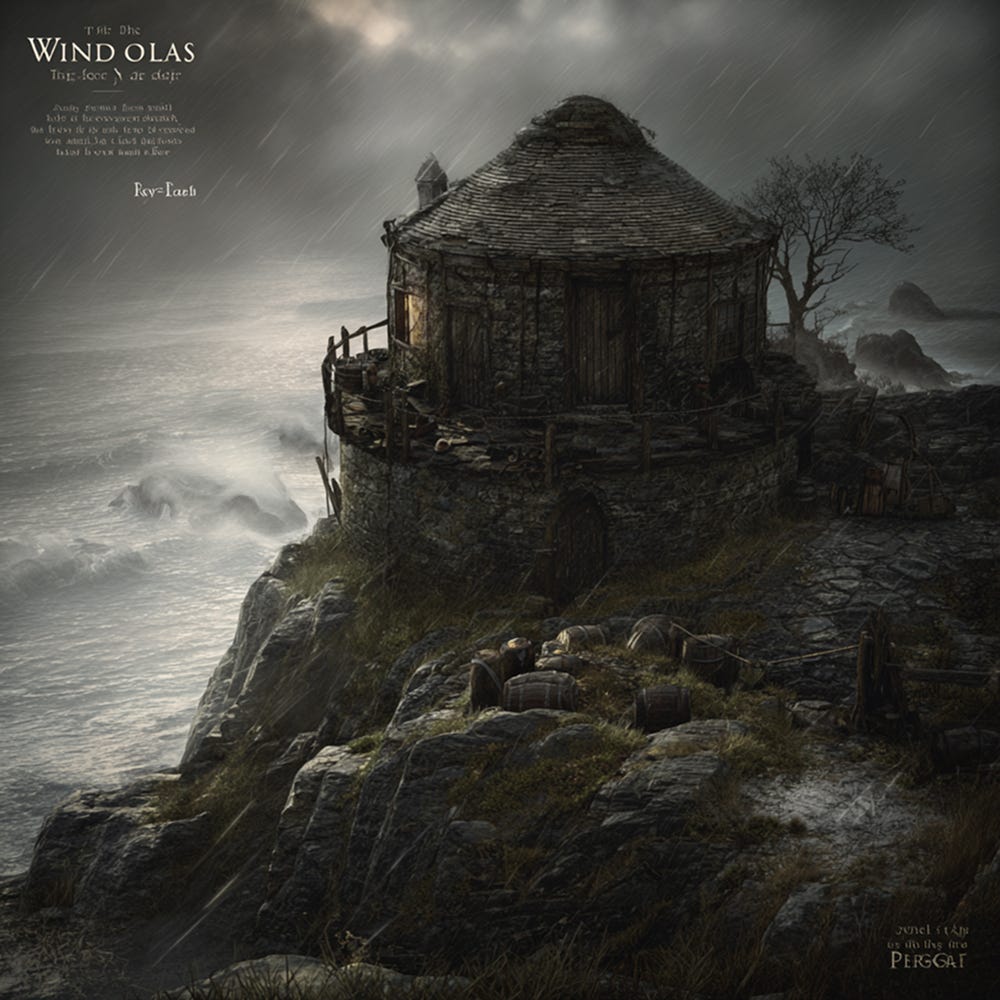
The road up the headland was more a dirt trail, barely paved and too steep for most wagons, cutting the ruddy heath of browning thistle and wild thyme. A trip of stunted goats, their thick browncoats matted and damp, grazed on the bushes of golden buckthorn where the heath fell away to the Aragean sea.
A lone fishing curach bobbed in the waters that sloshed in ebbs and flows against the tidewall rising from the beach of pebble and black sand. More would return at dusk with their briny gillnets full of mackerel and herring, to be grilled fresh for Bretons, or salted and sent by cart to Hart, and sometimes even as far as Lodor.
Out past the breakwater in the pale early mists they would push each dawn, the seafarers, toward the Isle of Mor where the fish were bolder, or east across the deep for mussels and whelks at low tide on the sunken reef.
And overlooking it all, defiant and proud atop the storm battered headland, stood the Wind’lass.
A two-storey roundhouse of dark oak and limestone, weathered grey by the yaren of salt and gale, it was here the fishermen, farmers and freemen about would gather after their labours for a drink or three and a warm-cooked meal. To the ‘Lass they would go, with the hearth always lit, where a stout and a tale brought a kind of richness to the life of an honest Breton.
Needed all the moreso, in these worried times.
Reardon the Poet had been her proprietor ever since Old Ronit set out at dawn for cockles and samphire, never to be seen again.
“Laying with the Storm Queen, and lucky blighter too,” the Bretons would toast with their horns of stout, and the Poet honoured the Old Seal’s passing with cockle and samphire soup served hot each Tidesday.
“Shouldn’t you be gettin’ that broth on the fire?” chided Maeg, crossing round behind the bar of old driftwood to pull a horn of stout from the tapped oak.
The Poet’s thick grey brows furrowed as he scooped up another cockle from the brine, rinsed off the grit, gave it a tap and tossed it in the pot full of cold stock and samphire.
“Don’t see you bustlin’ to help.”
“Bad enough I’ve the stink of old stout on me,” as she skimmed the froth with a flat wooden paddle worn soft as driftwood from lacing off ale.
For nigh on a yare Maeg had maided at the ‘Lass, since coming to Breton to live with her uncle. She knew the Old Seal and his damp demise only in soup and legend, but the Poet had earned in her orphaned heart something of a fatherly place, though he’d still not earned his name. Not to her ears, anyways.
“Don’t let ‘im try to short you on that one,” Reardon called after, as she carried the stout to Dirty Declan, oft the first in from the fields. The dark foam spilled over the lip of the horn and she cursed and wiped her hand on her apron. The ale mugs of clay didn’t spill, but the goat’s horns were half as wide and always did. Yet the Poet prided the ‘Lass on her horns, and would have his stout served in nothing less.
“That’s eight bits.”
“Eight?!” moaned Declan, “Pilfery! Ought to be five, for me ‘orn o stout!”
“Was five. Now it’s eight. You know we’ve no rye.”
“Aye, I know, lass! Ne’er mind me whole cabbage plot, rotted. An’ half me leeks!”
“Pox on yer leeks!” squawked Lottie the Grey from the table next, a pinch-faced woman with thinning wisps. “Three stillborns I birthed last moon, an’ another, young Marie’s, lost in her bloods. ’Tis an ill season, aye, an’ it’s more than cabbages an’ rye we’ve lost.”
“Worried times,” muttered Enit of Gull’s Head.
“Worried times,” muttered others around, in what might have been a commoner’s prayer, were the ‘Lass a temple for worship of more than stout and cockles.
“Lucky the fish have been bitin’!” called out Tall Ilard, who ran the largest curach in Breton.
Declan glared. “Aye, good fer business, is it?” the farmer growled, “a blighted harvest?”
“Heard you order yer cockle soup,” the fisherman retorted.
“Soup’s the only thing the Poet ‘ere hasn’t raised the price of!”
“You’re lucky we have any ale,” Reardon snapped from the bar, his yet bright eyes flashing irritably. “You find me some rye or barley they’re not askin’ an ear for, and I’ll drop the price of my stout.”
And he picked up the heavy pot and carried it to the kitchen out back. Maeg sighed and returned to the bar.
A bell that hung above the door jingled, and a breath of late Fall wind chilled the freckles on her forearms and she shivered.
Strangers were seldom enough at the ‘Lass, and moreso from outside the Five Hearths. And so it was enough to stop her step, these grey-cloaked, pale-robed strangers who came through the doors.
The first wiped the mud from his boots on the rushmat and crossed to the wide stone hearth around which the ‘Lass was built, to pull his gloves and warm his hands. She could not help but stare, with his bleached white hair and his bright blue eyes. The five who followed shrugged their hoods, revealing pates shaved smooth as riverstones.
A hush fell over the inn’s early patrons, gawking up from their horns.
“Find yourselves a seat,” Maeg called to the strangers, crossing back behind the bar. “I’ll be with you in a moment.”
Maeg, with her seventeenth winter approaching, and blessed as she was with her late mother’s eyes and father’s dimples, was well enough accustomed to the leering of men. She’d heard the talk of coming to the ‘Lass for ‘a horn o stout an’ an eyeful o’ sweet Maeg’s bosom’, thought it all harmless enough, sure, and at times played it up for the tips.
These men did not leer as she passed. Some of them glared, some averted their eyes, but she felt their reprove crawl on her skin, a cold and spiderly thing. Maeg flushed, wanting in that moment nothing more than a bath, though it hardly be the season for it. And though unaware, and had she been, would have chided herself, she shifted higher the bodice of her smock, and her shoulders stooped ever so slightly thereafter.
“Welcome to the Wind’lass,” called Reardon the Poet, returning from the kitchen. He wiped his hands on the soft brown rag that had hung from his belt for as long as the place had been his. “What can I get for you noble sers?”
“We are none of us nobles,” the white haired one spoke, in a soft voice that was yet compelling, and Maeg could not place the accent. “Rooms for the night. For myself, a single. Share rooms or bunks will suffice for my Brothers.”
“Don’t look like brothers,” snorted Declan at his horn, and the tallest stranger with the hardest scowl shifted his gaze to the farmer.
“Hush yerself!” urged Lottie the Grey.
“And feed and stables for our horses,” added the stranger.
“Ah, beggin’ yer pardon, ser,” Reardon simpered, “but we’ve only one room left, what with the festival an’ all. Ore merchants from north o’ the Shins came in on the yester, takin’ up three of the rooms ’til the morrow. I can offer you sers the one we have left, and bales and blankets in the cellar.”
The pale-haired stranger paused, still as the veiltide, and even Dirty Declan held his tongue.
“It’s dry,” said the Poet, “and there’s ale close at hand.”
Somebody coughed. Declan most likely.
“The cellar will suffice,” the stranger nodded.
Reardon brightened at the promise of coin. “Good then. Fine, fine. Take yerselves a seat at the table by the window. Supper and ale, while we ready the cellar?”
The stranger nodded to his companions, who shrugged their thick grey woollen cloaks and hovered by the hearth ’til Enit of Gull’s Head, sat alone at the longer table, up and shifted on Reardon’s order, none too pleased at that.
And while some of the patrons continued to stare, most then turned back to their stouts and their fears.
“You’re in luck,” sung the Poet, well in his stride now with patrons secured for the eventide’s trade, “it bein’ Tidesday an’ all. We’ve a soup on the fire of cockle and samphire, a house special here at the ‘Lass. Or we’ve Tomard’s catch from the morntide’s run, an’ finer herring you’ll not taste this time o’ the season.”
Tall Ilard snorted.
“Well, if you’ll go ‘an salt all yer catch for the festival,” Declan called back, “then what’s the Poet ‘a do?”
“Ain’t that the truth,” Reardon muttered. “We’ve also some goat and cabbage stew left from yester, only it’s kelp ‘stead o’ cabbage, on account o’ Declan’s patch goin’ sour. Maeg, bring these good sers a horn each of our finest stout!”
“We’ve only got one stout,” came her tart reply, but she fetched down the horns nonetheless.
“We’ll take the soup,” spoke their leader, “but water will suffice. And a cup of it hot, for a tea.”
“Aye, kettle’s on the fire, Maeg here’ll get your waters. If ’n you’d like to settle now, that’ll be six an’ five, two… call it one ’n dozen bones. Er, thirteen copper bonns, if’n ye please.”
The stranger took out a small purse of softside leather and drew from it a handful of coins, silver, each the size of a thin slice of crabapple. He placed two on the bar, slipping the rest back into their pouch.
“This will suffice, I trust?” and he lifted his pale blue gaze.
“Don’t get much ‘ears in ‘ere,” Reardon frowned, “not from this lot.”
But they were not Silver Eirs, Maeg noted, leaning across the bar. They were stamped with the bust of a laureled child, and etched in some sort of rune. She shook her head as the Poet lifted one of the coins and bit it in his teeth, mimicking the Lodor merchant who’d come through last summer, and left for the kitchen to fetch the waters.
She cursed the pale-haired stranger beneath her breath as she returned with her tray, for she’d scalded her palm on the kettle’s handle.
The stranger took from his satchel a small parcel of folded grey cloth. Laying it carefully open on the table, he pinched some of the dried leaves in delicate fingers, and sprinkled them into the steaming cup as she placed it down.
The tea smelled of heathgrass and honeysuckle, and it reminded Maegellin of summers in Aelwynd, when her father and brother were still alive.

I hope you enjoyed chapter 2, and I invite you to leave a comment. Your thoughts, or a question, anything you like.
You can find more chapters here.